





WeWork raised greater than $11 billion in funding as a non-public firm. Olive AI, a well being care start-up, gathered $852 million. Convoy, a freight start-up, raised $900 million. And Veev, a house building start-up, amassed $647 million.
Within the final six weeks, all of them filed for chapter or shut down. They’re the latest failures in a tech start-up collapse that traders say is barely starting.
After staving off mass failure by reducing prices over the previous two years, many once-promising tech firms are actually on the verge of operating out of money and time. They face a harsh actuality: Traders are now not curious about guarantees. Moderately, enterprise capital corporations are deciding which younger firms are value saving and urging others to close down or promote.
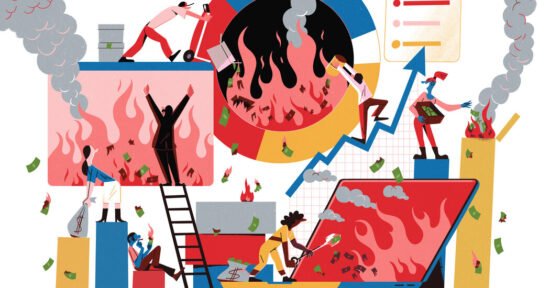
It has fueled an astonishing money bonfire. In August, Hopin, a start-up that raised greater than $1.6 billion and was as soon as valued at $7.6 billion, bought its principal enterprise for simply $15 million. Final month, Zeus Dwelling, an actual property start-up that raised $150 million, stated it was shutting down. Plastiq, a monetary know-how start-up that raised $226 million, went bankrupt in Could. In September, Hen, a scooter firm that raised $776 million, was delisted from the New York Inventory Change due to its low inventory worth. Its $7 million market capitalization is lower than the worth of the $22 million Miami mansion that its founder, Travis VanderZanden, bought in 2021.
“As an business we must always all be braced to listen to about much more failures,” stated Jenny Lefcourt, an investor at Freestyle Capital. “The more cash individuals obtained earlier than the get together ended, the longer the hangover.”
Getting a full image of the losses is tough since personal tech firms are usually not required to reveal once they exit of enterprise or promote. The business’s gloom has additionally been masked by a growth in firms targeted on synthetic intelligence, which has attracted hype and funding over the past 12 months.
However roughly 3,200 personal venture-backed firms around the globe have gone out of enterprise this 12 months, in accordance with knowledge compiled for The New York Instances by PitchBook, which tracks start-ups. These firms had raised $27.2 billion in enterprise funding. PitchBook stated the information was not complete and doubtless undercounts the full as a result of many firms exit of enterprise quietly. It additionally excluded most of the largest failures that went public, resembling WeWork, or that discovered consumers, like Hopin.
Carta, an organization that gives monetary providers for a lot of Silicon Valley start-ups, stated 87 of the start-ups on its platform that raised not less than $10 million had shut down this 12 months as of October, twice the quantity for all of 2022.
This 12 months has been “essentially the most tough 12 months for start-ups in not less than a decade,” Peter Walker, Carta’s head of insights, wrote on LinkedIn.
Enterprise traders say that failure is regular and that for each firm that goes out of enterprise, there’s an outsize success like Fb or Google. However as many firms which have languished for years now present indicators of collapse, traders count on the losses to be extra drastic due to how a lot money was invested over the past decade.
From 2012 to 2022, funding in personal U.S. start-ups ballooned eightfold to $344 billion. The flood of cash was pushed by low rates of interest and successes in social media and cellular apps, propelling enterprise capital from a cottage monetary business that operated largely on one street in a Silicon Valley city to a formidable world asset class akin to hedge funds or personal fairness.
Throughout that interval, enterprise capital investing grew to become stylish — even 7-Eleven and “Sesame Avenue” launched enterprise funds — and the variety of personal “unicorn” firms value $1 billion or extra exploded from a couple of dozen to greater than 1,000.
However the promoting income gushing from the likes of Fb and Google proved elusive for the subsequent wave of start-ups, which have tried untested enterprise fashions like gig work, the metaverse, micromobility and cryptocurrencies.
Now some firms are selecting to close down earlier than they run out of money, returning what stays to traders. Others are caught in “zombie” mode — surviving however unable to develop. They’ll muddle alongside like that for years, traders stated, however will more than likely battle to lift more cash.
Convoy, the freight start-up that traders valued at $3.8 billion, spent the final 18 months reducing prices, shedding workers and in any other case adapting to the tough market. It wasn’t sufficient.
As the corporate’s cash ran low this 12 months, it lined up three potential consumers, all of whom backed out. Coming so shut, stated Dan Lewis, Convoy’s co-founder and chief govt, “was one of many hardest components.” The corporate ceased operations in October. In a memo to staff, Mr. Lewis known as the state of affairs “the right storm.”
Such autopsy assessments, the place founders announce their firm is closing and replicate on classes realized, have change into frequent.
One entrepreneur, Ishita Arora, wrote this week that she needed to “confront actuality” that Dayslice, her scheduling software program start-up, was not attracting sufficient prospects to fulfill traders. She returned among the money she had raised. Gabor Cselle, a founding father of Pebble, a social media start-up, wrote final month that despite feeling that he had let the group down, making an attempt and failing was value it. Pebble is returning to traders a small portion of the cash it had raised, Mr. Cselle stated. “It felt like the fitting factor to do.”
Amanda Peyton was stunned by the response to her blog post in October in regards to the “dread and loneliness” of shutting down her funds start-up, Braid. Greater than 100,000 individuals learn it, and she or he was flooded with messages of encouragement and gratitude from fellow entrepreneurs.
Ms. Peyton stated she had as soon as felt that the chance and potential for progress in software program was infinite. “It’s change into clear that that’s not true,” she stated. “The market has a ceiling.”
Enterprise capital traders have taken to softly urging some founders to contemplate strolling away from doomed firms, fairly than waste years grinding away.
“It is perhaps higher to simply accept actuality and throw within the towel,” Elad Gil, a enterprise capital investor, wrote in a weblog publish this 12 months. He didn’t reply to a request for remark.
Ms. Lefcourt of Freestyle Ventures stated that up to now, two of her agency’s start-ups had carried out precisely that, returning 50 cents on the greenback to traders. “We’re making an attempt to level out to founders, ‘Hey, you don’t wish to be caught in no man’s land,’” she stated.
One space that’s thriving? Corporations within the enterprise of failure.
SimpleClosure, a start-up that helps different start-ups wind down their operations, has barely been in a position to sustain with demand because it opened in September, stated Dori Yona, the founder. Its choices embrace serving to put together authorized paperwork and settling obligations to traders, distributors, prospects and staff.
It was unhappy to see so many start-ups shutting down, Mr. Yona stated, nevertheless it felt particular to assist founders discover closure — each actually and figuratively — in a tough time. And, he added, it’s all a part of Silicon Valley’s circle of life.
“Lots of them are already engaged on their subsequent firms,” he stated.
Kirsten Noyes contributed analysis.